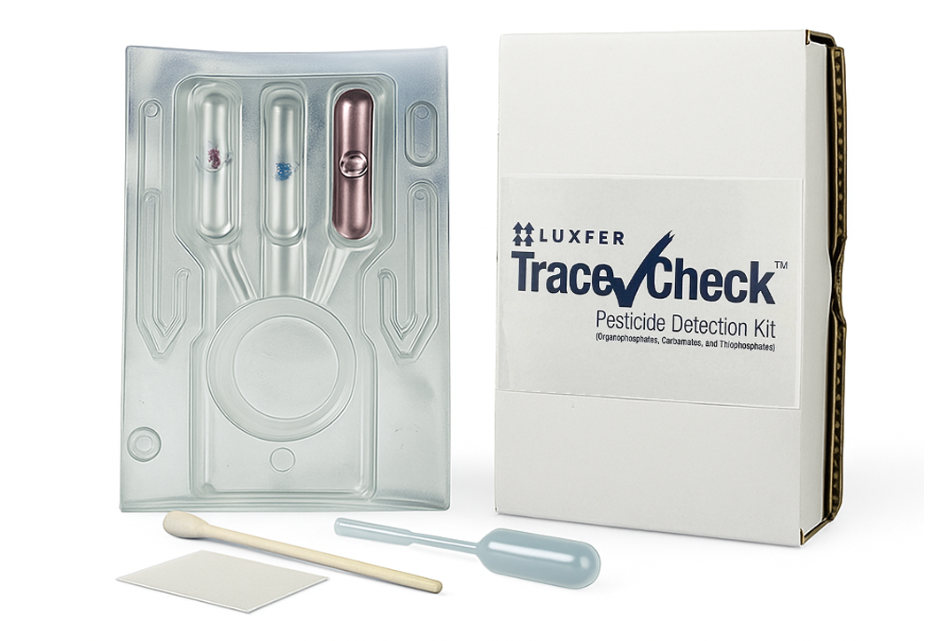
What TraceCheck™ Detects
TraceCheck™ has been specially formulated to identify three of the most hazardous classifications of pesticides found in field and contamination scenarios:
Organophosphates — including Acephate, DDVP, Monocrotophos, Fenitrothion, Methamidophos and more
Thiophosphates — including Chlorpyrifos, Malathion, Parathion, Diazinon, Dimethoate and more
Carbamates — including Aldicarb, Carbofuran, Carbaryl, Methomyl, Oxamyl and more
With very high sensitivity capable of detecting extremely low concentrations, TraceCheck™ doesn’t miss what others might. A broad-spectrum approach means a single kit screens for multiple threat categories simultaneously — making it one of the most comprehensive point-detection solutions available for field use.
How It Works
1
Open packet and remove contents. With arrows facing downward, Crush Ampoule #1 (See Proper Ampoule Crushing Procedure). Rotate the unit to saturate entire detection spot. Shake to remove excess liquid.
2
Obtain sample, then apply to the detection spot. Liquids: Use pipette: Apply 1–2 drops maximum. Solids: Use cotton swab: Gently roll all sides of the swab over spot.
3
With arrows facing downward, Crush Ampoule # 2.Rotate to saturate the spot. Allow to sit for 2 minutes. → If the temperature is below 50°F, warm the unit during Step 4 by holding it between gloved hands
4
With arrows facing downward, Crush Ampoule #3. Rotate to saturate spot. Allow to sit for 10 minutes. Black or blue hollow circle the pesticide present.
First Responders
When responding to a potential pesticide exposure incident, time is the single most critical factor. The TraceCheck Pesticide Detection Kit gives first responders a decisive edge, delivering results in just 10 minutes directly at the scene. There’s no waiting for expensive lab analysis or specialist equipment — a result is in your hands before the situation has a chance to escalate. The simple three-ampoule process requires minimal training, meaning any qualified team member can deploy it confidently under pressure. Its ability to test liquid and solid substances using just a pipette and cotton swab makes it practical across a wide range of incident types, from suspected contaminated water supplies to unknown substances on surfaces. The kit detects a broad spectrum of dangerous pesticides including organophosphates, thiophosphates, and carbamates — many of which pose serious neurological risks to civilians and responders alike. With a five-year shelf life, units can be stocked in vehicles and emergency kits without frequent rotation. At a fraction of the cost of electronic sensors, departments can equip multiple teams simultaneously, ensuring rapid coverage across large incidents. For any first responder unit dealing with chemical hazard environments, TraceCheck is a practical, affordable, and potentially life-saving field tool.

Agriculture
For farmers, agronomists, and agricultural businesses, pesticide management isn’t just a regulatory obligation — it’s central to product quality, worker safety, and commercial reputation. The TraceCheck Pesticide Detection Kit offers the agricultural sector a fast, cost-effective way to screen soil, water, plant material, and surfaces for pesticide contamination without sending every sample to a laboratory. Results arrive in just 10 minutes, allowing decisions to be made in the field rather than days later. This is particularly valuable during harvest periods, where timely detection of contamination can prevent entire crops from reaching market with unsafe residue levels. The kit’s ability to detect a wide range of commonly used pesticides — including chlorpyrifos, malathion, carbaryl, and carbofuran — means it is relevant across diverse farming operations, from arable to horticulture. For smaller operations watching margins closely, TraceCheck eliminates the expense of routine lab testing for every suspect sample, reserving costly analysis only for confirmed positives. Worker safety programmes also benefit, as irrigation water and treated areas can be quickly screened before staff re-enter. With a five-year shelf life and straightforward usage, it integrates easily into existing farm safety protocols, providing growers with genuine peace of mind and a measurable layer of due diligence in day-to-day operations.

Military & Defence
In military and defence operations, the ability to rapidly assess chemical threats in the field can mean the difference between mission success and catastrophic loss. The TraceCheck Pesticide Detection Kit provides CBRN units and forward-deployed personnel with a compact, easy-to-use screening tool capable of detecting organophosphate-based compounds — a chemical family that underpins some of the world’s most dangerous nerve agents. Within just 10 minutes, operators can screen suspect surfaces, soil, water, and solid materials without relying on bulky electronic equipment or remote laboratory support.
The three-ampoule system is designed for simplicity under pressure, requiring minimal steps and delivering a clear indication of whether dangerous compounds are present. For units operating in environments where pesticide-based chemical weapons or contaminated supply routes are a credible threat, TraceCheck offers an affordable and deployable first-line screening capability that integrates seamlessly into existing CBRN protocols. Its five-year shelf life makes it ideal for pre-positioning in forward operating bases, vehicle kits, and emergency response caches. As a product from Luxfer Magtech — a trusted name already embedded in defence and humanitarian supply chains — TraceCheck carries the credibility and reliability that military procurement demands. Fast, fieldworthy, and cost-effective, it is a practical addition to any CBRN toolkit.
Enquire Now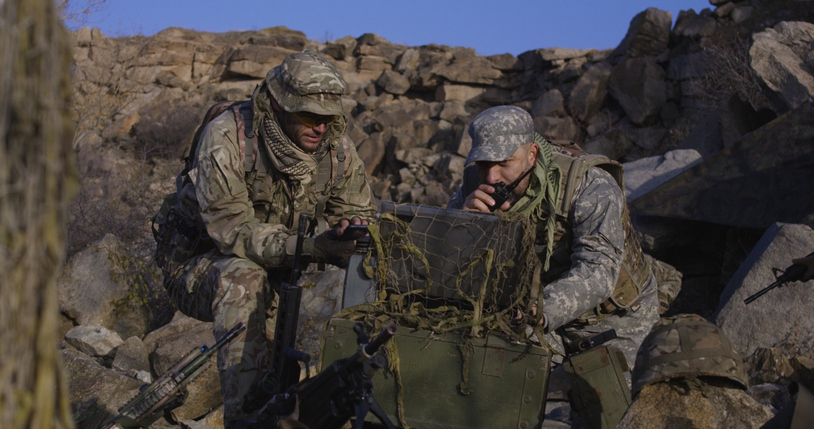
Technical Breakdown
Product Design & Detection Mechanism TraceCheck uses an enzymatic inhibition method. The white reaction area contains immobilised acetylcholinesterase (AChE) enzyme. If no pesticides are present, the enzyme remains active and the area turns blue. If pesticides are detected, they inhibit the enzyme and the spot remains white — a clear, binary pass/fail result requiring no interpretation equipment. Three-Ampoule Reagent System Each kit contains three glass ampoules activated sequentially: Ampoule 1 delivers a buffer solution to maintain the enzyme's optimal pH. Ampoule 2 contains a conversion solution that enhances binding of weaker enzyme inhibitors, broadening detection capability. Ampoule 3 contains a chromogenic substrate that triggers the colour change when the enzyme is uninhibited. Sensitivity & Detection Limits Solids (surfaces/soils at 68°F): detects down to 5 µg (NLT). Liquids (water/surfaces at 68°F): detects down to 50ppm (NLT). Malathion was used as the confirmation benchmark as it has the weakest acetylcholinesterase inhibition — meaning stronger-affinity pesticides are detectable at even lower concentrations. Pesticide Classes Detected Organophosphates, thiophosphates, and carbamates — covering compounds including Chlorpyrifos, Malathion, Parathion, Carbofuran, Aldicarb, and many others. Operational Parameters Operating temperature range: 35–110°F. Below 50°F, reaction speed slows and the unit should be warmed in the palm of a gloved hand after Ampoule 3 is applied. Results are delivered within 10 minutes for both solid and liquid samples. Sample Collection Solids: external cotton swab rolled across suspect material, then applied to the detection spot. Liquids: pipette used to apply 1–2 drops maximum. The spec notes a 50% assumed sample transfer efficiency from swab to reaction area. Important Limitation Results are presumptive only. Positive findings must be confirmed by validated laboratory analysis before any formal reporting or operational reliance, as other chemicals may produce comparable enzyme inhibition reactivity. Packaging & Storage Each unit is individually sealed in a foil pouch with desiccant. Sold in boxes of 5, with customisable carton quantities. Storage at ambient 65–75°F or cooler. Shelf life: 5 years.
| Service | V1 | V2 | V3 |
|---|---|---|---|
| Providing a market appraisal and general advice as required | |||
| Advertising and carrying out viewings | |||
| Selecting and referencing of tenant including credit check | |||
| Right to Rent and Sanction Checking | |||
| Safety Certificates for Gas & Electricity * | |||
| Rent and Legal Protection cover * | |||
| Preparation and signing of Tenancy Agreement | |||
| Collection of First Rental Payment | |||
| Annual income and expenditure reports |